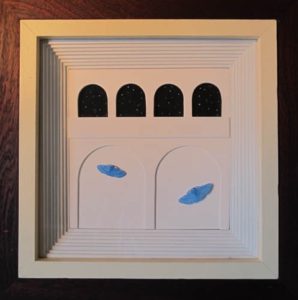
Genesis
In the beginning
In the beginning
nothing had any form,
there was just a void
of deep, dark waters;
my spirit hovered.
I called for a Light,
the comfort of Wisdom,
and boldly she danced
across my cold heaven.
She taught me a language,
so, I formed, constructed;
while she mingled wines
to lighten my knowledge.
And it all felt so good,
days warm and bright
containing the darkness
inside my nights.
A week of work began!
I set firm the horizon
between earth and heaven,
kept the world separate
to my own perfection.
I divided the species,
the seasons, the hours,
put the moon in a vault,
determined the stars.
I willed every person
to live in my image,
but happier, lovelier,
free from my knowledge.
Now I needed no helper,
so she no longer stayed,
returning to a palace
alone with her maids.
Evenings were boring
by the seventh day,
but all seemed okay,
so, I rested.
2018
Could it have all been different?
And in that garden, the man saw that the tree was good for food to eat, pleasant to the eye and a tree to be desired to make one wise; and he took of the fruit and gave some to the woman, who said to him, “Don’t be so stupid, put that down now! Has God not told us that in the day we eat of that tree we will surely die?”.
Then the man was afraid and regretted what he had done and resolved to crush me, the snake who had led him on, with his heel; but the woman spoke to him calmly, “Haven’t you caused enough trouble already? I will speak to God when She walks amongst us in the coolness of the evening”.
When God heard what had happened, She smiled and picking up the fruit went down to the Pishon river; and after She had bathed God ate that fruit, the fruit the man had desired and chosen. I crawled away to another garden.
The man remained with the other species, naming their variations as if they’d been created as separate animals and plants. The woman looked up into the moon, planets and stars, imagining them to be lights that shine in the heavens, just signs to mark time and the season.
We can all imagine that other Eden, a golden garden on the river Pishon where God smiles down on ignorance. Today, tomorrow, next month or next year, we can squint our eyes and say, “That’s where I should have lived – that land without thorns or snakes or sacrifices!”; but please, for the sake of everything we should all hold dear, do not ever try and go there.
2014.
Cain
And so I’m back, drenched in rain,
jagged shoulders pulled round my brain;
another cold night with nothing to dream,
naked in metropolis but never seen.
Now I have no soul to save,
no mind to use, no feelings to brave;
just stumbling through the dark,
a lost dog in an empty park
barking at one more brief shiny light,
pining for life’s fickle paradise.
1985
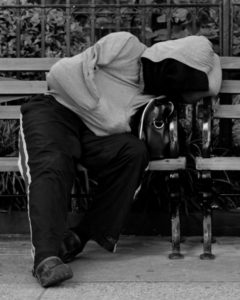
To Enoch (from his mother)
I wasn’t introduced to your father, I found him wandering, pleading with someone who wasn’t there. I called; he came over, knelt, put his ear to the soil and wept.
He grew up on a farm out west, with his parents and brother, Abel, the favourite, a bold, even-tempered man who kept sheep. I met him once, he could fight a bear, shear a fleece, ease milk from a teat and then at the right time kill and share meat. Your father saw angels in smoke, heard them in fire. Once, to make the voices stop, he did what they said and killed his brother, the best of the flock.
Those days in this dry land, so far east of Eden, no-one called upon the name of God: without a tribe, I survived the rough ways of men as I could. I showed Cain a room, gave him a price. He busied himself: built this city with plumb line, filled it with babbling tribes to try and stifle the voices that were telling him he was cursed.
I found herbs that soothed him, and in time I loved him; but he remained tormented. Now he has left and given the city your name. Sometimes I see you bear the mark of his lonely shame. Take this sheepskin as an inheritance. It was left by your uncle. His strong arms lifted it from a ewe, so she stood naked. Abel was convivial, the touch of his fingers was timely and gentle.
2025
Noah’s Fossils
Can you remind me who came to our wedding? Who assembled the tents in which we danced, who played flute, who served the meats and all those wines? Do you remember Tubal-Cain? His name I can never forget: he held this bronze sword above us, the one forged to protect his sister, Naamah.
I don’t know how many years after the wedding it was – that last night on the waters – as you slept I crept up to the deck to watch the moon’s first touch on the tips of the reappearing mountains and I remember kissing the gopher-wood gunnels for they still held the smell of the old forests that were east of Eden. The following morning our sons, their wives, you and I stepped onto the damp sediment and as we searched for boulders to build our first altar I feared we’d discover the raven, picking at a sodden carcass – a wedding guest or some other acquaintance.
Yesterday morning I tried to teach our grandchildren how to plant seeds but some of them left to dig for fossils. In the evening I went down to the cellar to taste my wines, I stumbled into an un-swept corner and standing there was the bronze sword. This morning I banished our second son because last night he came into my room as I slept, drunken, without you, and looked on my nakedness. He understands me now and I am more ashamed than Adam. Tonight when you kiss him farewell give him the bronze sword of Tubal-Cain, tell him that Naamah bore heroes who did not call upon the name of God, that before the flood we spoke one language and God feared us and cursed us but as for me I tilled the ground quietly and God called it righteousness.
As I slept on deck in that last night on the waters, beneath the moon and the circling raven, I saw the sword stuck into the stern; and every night since then Tubal-Cain’s splintered fingers have clung to the bows of my crowded, bestial dreams.
And yesterday morning I tried to teach our grandchildren how to plant seeds but those of our second son left me to go and search for fossils.
2013
The Stories of Abraham
The stories of Abraham
I appeared, once again, to the slave girl Hagar (she was lost with her son in the desert of Beersheba),
“Hagar! What is the matter Hagar?”
She answered back through parched lips,
“The matter, Angel, is God’s injustice,
whom he has blessed and whom he has punished!”
Fixing the heavens with a glare, she said,
“Listen!
I was taken from my home on the Nile and given
to Lot an orphan and his uncle Abram
who’d sold a wife into Pharaoh’s harem,
receiving sheep and I as a bargain.
Abram took me from my home on the river,
that trickster, trader, that pimp and failure,
and Sarah his wife transmitted plague,
Pharaoh returned her with gold and slave,
the wealth that drives one man from another –
so, Lot took off for Sodom and Gomorrah,
while I remained with Sarah and Abram
rich and childless in the land of Canaan.
I came down from my heights, put a hand on her shoulder:
“Hagar! Abram is more than trickster and trader, he’s a prophet and priest, a statesman and soldier, who fought and defeated the kings of Canaan, circumcised himself and his kinsmen in a covenant with God who named him Abraham. The stars shone a vow he’d sire a nation, though Sarah his wife was old and barren.”
Hagar aimed her son’s pale face, an arrow to my convivial gaze and said,
“Sarah sneered at your God in disbelief
then told her Abram to give me his seed;
she watched him hurry into my tent
then she bullied me when I was pregnant.
I fled but you came and promised children
if I returned to her ruthless sarcasm.
The matter for me, Angel, is God’s injustice,
whom he has blessed and whom he has punished.
Sarah bore Isaac, but despite this mercy
demanded of Abram one more cruelty:
I, still their slave despite giving birth,
was sent away to this dry desert.
Now, Ishamel my son is dying of thirst
whilst her frail Isaac inherits the earth!”
She was right of course, we had met before, and even though I had made that vow, Abraham had sent her out to Beersheba, with a loaf of bread and a skin of water. Her complaints were valid but I still considered that what she had suffered through Sarah’s anger and Abraham’s betrayal was part of God’s plan and all would be well.
“Hagar! Abraham is a comic who is courageously standing for justice. I will tell you how he teased God for planning to slaughter every last person in Sodom and Gomorrah. He approached Him, came near saying, ‘Lord, may I be so bold as to ask, I who am nothing but ashes and dust, should not a judge do what is just? Will you burn innocent with evil, or hold back your wrath for fifty good people?’ And God agreed with that cunning old joker and said that for that fifty in number he would not burn Sodom and Gomorrah. But our trickster-trader didn’t stop there. “Lord, what if there were just forty-five?’ Then knocked it down to forty, then thirty-five and finally Abraham cried, ‘Lord, for the sake of just Lot, his in-laws and children will you hold back your judgement on Gomorrah and Sodom?’
And God in unusual mercy took away the fire, as we in heaven looked down in awe at the clever irony of that saviour, Abraham – whose wife you mocked when she was barren.”
“I will mock every woman who plays a part,
in the plans of God and those patriarchs:
Abraham sold Sarah twice as a concubine,
first in Egypt, then to a Philistine;
Lot once readied his daughters for rape,
now he’s gorging wine in a cave;
his wife, a rock, weeps salt in shock
as their daughters tease the seed from Lot’s […]”
“Stop! Hagar, please stop. Hagar, in this wilderness there is hidden water, bring Ishmael up here, alone as an archer, accurate in love as well as in anger; then take him home to meet an Egyptian – a woman of the land from where you were taken by Lot, an orphan, and his uncle Abram.”
Years later, Hagar sent Ishmael back from Egypt to Canaan to help his half-brother, Isaac, bury Abraham. But you don’t recall that loving reconciliation. What you remember, the story that’s filled the world with wonder, is that after saving Lot’s life, Abraham complied with orders to sacrifice his own son, teasing Isaac, ‘God will provide’, before strapping him down, reaching for a knife. He would have killed him there on a shrine … but I called out God’s punch-line just in time: ‘A ram is caught by its horns in a thicket!’ And by faith, you say, Abraham got away with it, put down the knife, became the protagonist, first Jew, perfect Muslim, Saint Paul’s prototype Christian?
Sometime later, God did set fire to Sodom and Gomorrah: as the lightning struck I leapt from heaven and became Satan, Azazel, the angel fallen. The matter was not my pride, it was God’s injustice: whom he had blessed and whom he had punished. Now decide for yourselves, travellers, where you will seek rest: in the mansions of God or my wilderness.
2013
Epithalamion: Isaac’s sonnet for Rebecca
Perhaps your presence has carried me back
to a time that was simpler and true?
Or maybe you took me to heaven,
a place known only to you?
Did you take me inside of myself,
through the tender tunnel of memory,
pulling the pearl out of my shell,
touching the tensions that closed me?
Well, somewhat. We met on the same road
leading out of a damaged land;
and we walked with each other,
sharing the past and suggesting the path:
a smile, a joke, recognition,
an embrace, understanding, a kiss.
2006
“The Art of Peace”. Speech by Lieutenant General (Retd.) Basemath.
I am the daughter of Ishmael the great archer who was the son of Abraham and Hagar; my husband Esau was the greatest hunter after Nimrod and the son of Isaac and Rebecca. Esau’s brother, Jacob, was our enemy: he was physically frail, walked with a limp, but carried unusual courage and cunning. It was said he would wrestle an angel if he thought that could win him a blessing.
Jacob’s agents had spread propaganda about his wealth and power, and his spies studied our army’s numbers and strength. We remained focused on our own strategy. Our reconnaissance squadrons tracked Jacob’s regiments to their assembly area at Mahanaim. They watched a detachment of Jacob’s engineers set a pontoon bridge across the Jordan, over which rolled a lightly-armed Supply Unit. I suspected this was a feint and this proved prescient the following night when my scouts observed Jacob’s spearhead battalion crossing the river in the dead ground further south. Esau’s vanguard by-passed the Supply Unit deployed to divert him and headed south towards Jacob’s Main Effort. Jacob feared he would not get all his echelons across the Jordan before first contact, and so his tactics became more desperate and underhand: believing Esau to be wild and impulsive, he put children amongst his front-line troops and tried to lure his brother into war crimes by standing on the high ground and bowing to him, ironically, seven times. Jacob had underestimated Esau (whose passions were now tempered by my good counsel) and misunderstood our tactics. Esau and men from his Hunter Troop sprang from a position that was defilade to Jacob’s Headquarters: Esau pounced on his crippled brother, throwing red-haired brawny arms around his sloping shoulders and kissing him.
That night, Esau and I rejoiced that our children would not need to carry the cruel and inglorious weapons of war, but would instead pick up the plough and hold the pen that would protect them from famine. We had won peace, but all victories come at a price. Jacob patronised Esau, persuading him to accept as gifts prizes that a warrior would have taken by force; and his people were not easy neighbours: snubbing our attempts to walk alongside them, they lived in their own castles and farms. But there was peace, wonderful, productive peace, and that was and is worth everything.
2020
Joseph’s song for Asenath
Here is one more song about our moon –
Its fullness depends on another orb’s light
Here is a new song about the moon
Showing the same face through billions of nights.
One upon a time in June’s late darkness
I crept to the fields, ran naked and reckless
In a night when no-one could catch me –
in the moonlight I felt I was free.
The stars and the corn did not bow down
But they winked in the clouds and the breeze.
And their loneliness reassured me.
Thirty years after my unnoticed race
I’m wrapped in a coat and consolation.
My Love comes to me she does not question –
The moonlight shines full on her face.
The stars and the corn do not bow down
But they wink in the clouds and the breeze
And their loneliness reassures me.
This is one more song about our moon –
Its fullness depends on another orb’s light
Here is a new song about the moon
Showing the same side through billions of nights.
The stars and the corn will not bow down
But they’ll wink in the clouds and the breeze.
And my loneliness is part of me
So Love come sit beside me.
2011